This AI Is Not Here to Replace Your People.
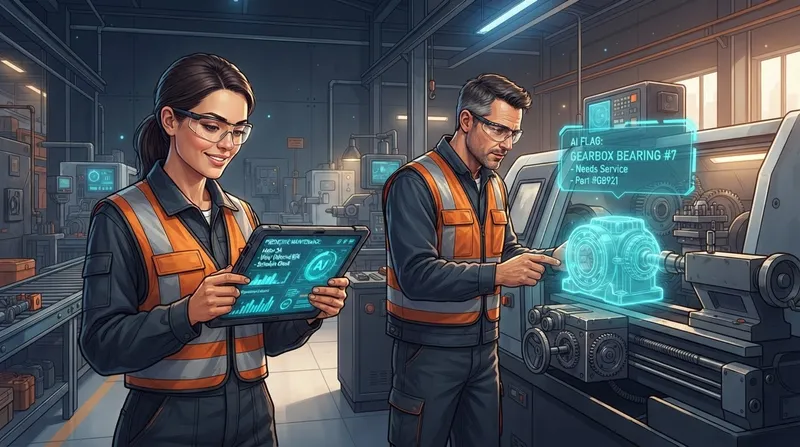
Tor Hydra’s predictive AI is a tool for your technicians and engineers – not a replacement for them.
Let’s Address It Directly
We Know the Question Is on the Table.
Any conversation about AI in industrial settings eventually gets here: “What does this mean for our maintenance team? Our reliability engineers? Our operators?”
It’s a fair question, and it deserves a direct answer.
Tor Hydra’s AI does not replace human judgment. It extends it.
Here’s what that actually means in practice.
What the AI Does
What Tor Hydra’s System Does
- Monitors sensor data continuously – 24 hours a day, 7 days a week, without fatigue
- Detects subtle anomalies that fall below human perception thresholds
- Generates early warnings before symptoms become symptoms
- Prioritizes where attention is needed across many assets simultaneously
- Provides condition scores and trend data to inform decision-making
What it does not do:
- Decide which repair to make
- Touch a machine
- Replace the diagnostic expertise of a seasoned technician
- Manage your team
- Understand the operational context that your people carry
What Humans Do
What Your Team Does – With This Tool in Place
Experienced maintenance professionals and engineers bring things to a situation that no model can replicate:
- Contextual reasoning – “That reading looks off, but we changed the load profile last week.”
- Physical intuition – Years of listening to, feeling, and interpreting machines in person
- Judgment under uncertainty – Knowing when to act now vs. monitor vs. wait
- Cross-system knowledge – Understanding how one system failure cascades into another
- Relationships and communication – Coordinating across operations, procurement, and safety
The AI surfaces the signal. Your people make the call.
The Real Shift
What Actually Changes
What changes with Tor Hydra in place isn’t who does the work. It’s how the work gets done.
Before predictive AI:
- Reactive maintenance – fix it after it breaks
- Time-based maintenance – replace parts on a calendar, not on condition
- Alert fatigue – too many alarms, too little signal
- Technicians dispatched based on tickets, schedules, or gut feel
- Nurse running into an ICU responding to an alarm
With predictive AI:
- Condition-based maintenance – act when the data says to
- Prioritized attention – focus resources on what actually needs it
- Higher signal-to-noise – fewer false alarms, more meaningful alerts
- Technicians go in knowing what they’re looking for before they arrive
- Nurse alerted to potential future problem with ICU patient before it happens
That’s a better job – not an eliminated one.
Efficiency Reframed
“Efficiency” Doesn’t Mean Fewer People. It Means Better Work.
There’s a tendency to equate automation with headcount reduction. That framing misses what’s actually happening.
Predictive AI makes your existing team more effective. A maintenance technician who receives an early, specific alert – “Bearing 3 on Pump Unit 7 is showing a 14% increase in vibration amplitude trending upward over 9 days” – can:
- Arrive prepared with the right parts
- Spend time fixing, not diagnosing
- Avoid an emergency breakdown that would have taken 12 hours to resolve
- Log accurate condition data that improves future predictions
That technician isn’t replaced. They’re equipped.
Our Commitment
Our Commitment to Honest AI
We don’t believe in deploying AI that obscures what it’s doing, removes human oversight, or makes consequential decisions in isolation. In industrial environments, the stakes are too high for that.
Tor Hydra’s systems are designed to be:
- Transparent – every alert includes the contributing sensor data and confidence level
- Supervisory – the AI advises; humans decide
- Auditable – predictions and outcomes are logged and reviewable
- Interruptible – operators can override, pause, or reconfigure at any time
The people running your facility remain in control. That’s not a disclaimer. It’s a design principle.
Questions About How This Fits Your Team?
We’re happy to talk through what a Tor Hydra deployment looks like operationally – who interacts with it, what the alerts look like, and how it integrates with your existing maintenance workflows.